Why This Matters in 2026
As we navigate the mid-2020s, the efficiency of blood donation drives relies heavily on the user experience provided to potential donors. In previous years, donors often navigated clunky websites or waited for manual confirmation, which served as a significant deterrent to regular participation.
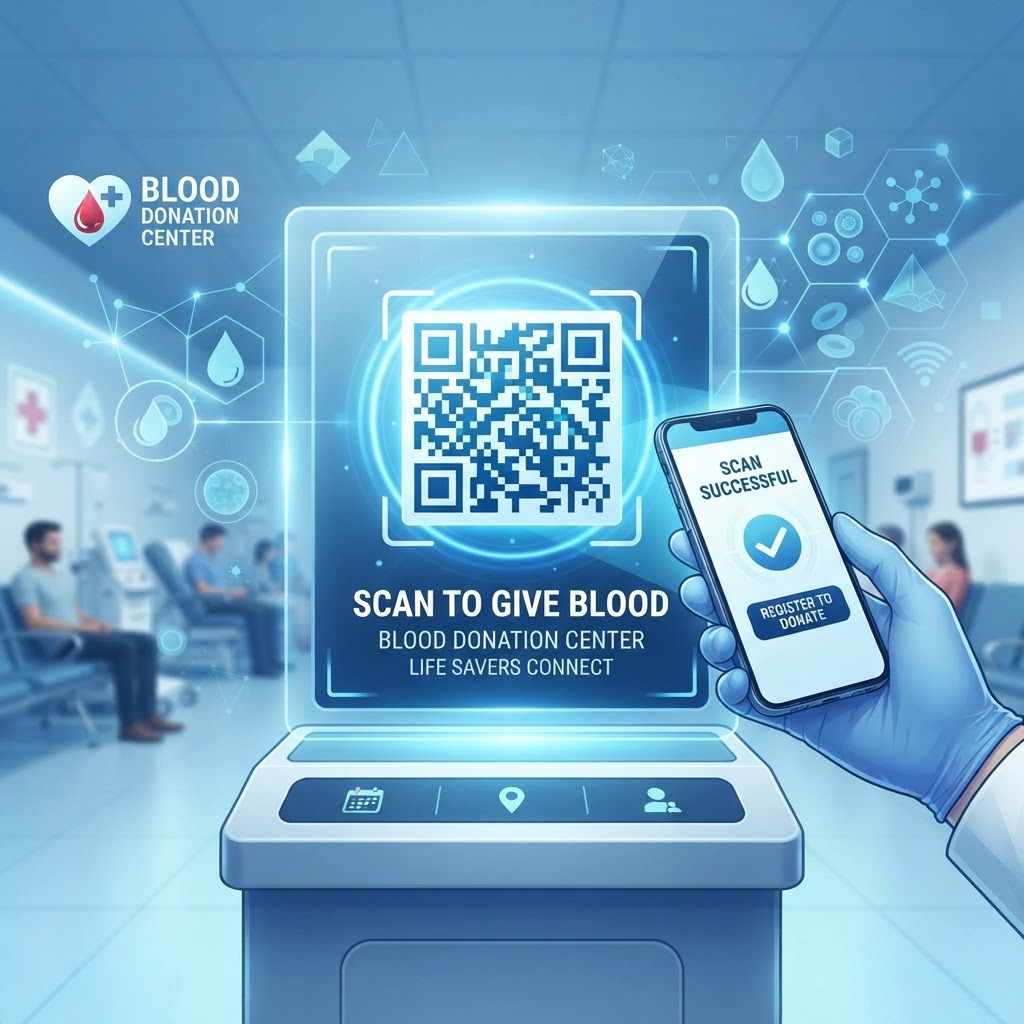
Today, the ubiquity of high-speed mobile internet means that donors expect instant gratification. A qr code for blood donation center acts as a direct conduit from a physical advertisement—such as a flyer at a coffee shop, a poster in a school, or a sticker on a public transport vehicle—straight to the point of conversion. By minimizing the number of clicks required to sign up, centers can significantly lower their drop-off rates.
Furthermore, in 2026, donors value safety, hygiene, and efficiency. The shift toward paperless operations is not merely an environmental choice but an operational necessity. By replacing paper intake forms with digital gateways accessed via a QR code, donation centers can streamline the triage process, reduce the administrative burden on nursing staff, and decrease the physical footprint of donation stations.
Many businesses and healthcare organizations have successfully adopted this approach to maintain organizational flow. When a donor scans a QR code, they are greeted by a mobile-optimized interface that can manage capacity in real-time, preventing the bottlenecking of waiting areas.
This transformation in donor management ensures that the donation process remains safe and professional, while also allowing centers to better segment their donor database for future outreach campaigns through automated digital tracking. The shift is not just about convenience; it is about leveraging technology to save more lives by removing every possible barrier that sits between a healthy individual and the donation bed.
Key Points
- QR codes connect physical advertisements directly to donor signup and appointment tools.
- Digital intake can streamline triage and reduce the administrative burden on nursing staff.
- Mobile-friendly experiences and real-time capacity management can help prevent bottlenecks.
How It Works Technically
The technical architecture behind a qr code for blood donation center is surprisingly robust yet elegantly simple. At its core, a QR code is a matrix barcode that encodes a specific URL or digital instruction into a two-dimensional grid of black and white pixels.
When a smartphone camera scans this grid, the phone’s operating system decodes the pattern and instantly triggers a web browser to navigate to the destination URL. For a blood donation center, this URL typically directs to a custom landing page hosted by the center, a booking platform, or a digital intake form. Because the process is handled entirely at the application layer of the mobile device, it does not require specialized hardware, ensuring that any donor with a standard smartphone can participate.
Most modern smartphones now have integrated QR scanning capabilities directly within the camera app, removing the need for third-party software downloads. From a backend perspective, when a donor scans a QR code generated by a service like blueqrcode.com, the traffic is directed to an endpoint where metadata can be tracked if using a dynamic QR code.
This allows the center to monitor which physical location—such as a specific community center, high school, or corporate lobby—is generating the highest number of signups. This attribution data is invaluable for resource allocation, allowing managers to focus their advertising efforts on the most responsive demographics.
Furthermore, the security of these transactions is maintained through standard HTTPS protocols, ensuring that sensitive donor information remains encrypted during the registration process. By utilizing mobile-responsive design at the destination URL, the center ensures that the data collection process is seamless, regardless of whether the donor is using an Android or iOS device, providing a consistent, professional, and secure experience that builds trust and encourages repeat donations.
Step-by-Step Guide Using blueqrcode.com
Creating a qr code for blood donation center is a streamlined process when you utilize the intuitive tools provided at blueqrcode.com. Follow these steps to create and prepare a code for your donors.
- Choose a destination: Identify the digital destination you want your donors to visit. This might be a direct link to your online appointment scheduling tool, a digital health history questionnaire, or a landing page featuring information about the immediate need for specific blood types.
- Open blueqrcode.com: Navigate to the website and select the URL category to ensure the QR code is formatted for universal scanning.
- Enter your link: Paste your destination link into the provided field.
- Customize the design: Use the available options to adjust the color scheme or add a subtle logo to the center of the QR code. This helps build brand recognition and signals to the user that the scan is legitimate and affiliated with your organization.
- Generate and download: Click the generate button and download the code in a high-resolution format, such as PNG or SVG, which are ideal for print projects.
- Test the code: Before printing thousands of posters, perform a test scan with multiple mobile devices to ensure the redirect functions correctly.
- Consider a dynamic URL: If your platform supports it, use a dynamic URL to update the destination link in the future without needing to reprint your marketing collateral. This makes it easy to pivot from promoting one donation drive to another without losing the equity of the posters already deployed in the field.
Best Practices for Deployment
Effective deployment of a qr code for blood donation center requires careful consideration of physical placement and visual context. Prioritize accessibility, code size, and legibility so donors can scan easily.
- Choose accessible placement: Place poster codes at eye level, roughly 5 to 6 feet from the ground. For table tents or registration desks, position them centrally and away from cluttered areas that might confuse the camera’s autofocus.
- Use an appropriate size: For most indoor scenarios, a minimum dimension of 2 inches by 2 inches is recommended to ensure that cameras can capture the image even from a few feet away. In high-traffic outdoor settings, such as billboards or bus stops, make the code significantly larger to compensate for distance.
- Add a clear call to action: A QR code by itself is an abstract graphic that offers no context. Use concise language such as "Scan here to book your life-saving appointment in 30 seconds" or "Scan to check eligibility for today’s blood drive."
- Maintain sufficient contrast: Black on white is the industry standard, but dark blue or deep green on a light background can work if the contrast ratio remains high.
- Avoid glare: Avoid glossy lamination if possible, as it creates glare that can render the QR code unreadable under bright fluorescent or direct sunlight conditions.
By prioritizing legibility and context, you increase the likelihood that passersby will convert into active, registered donors.
100% Free — No signup required
Create your Qr Code For Blood Donation Center in seconds
Create Free QR Code →Common Mistakes to Avoid
Even with the best intentions, many organizations fail to reap the full benefits of a qr code for blood donation center by committing easily avoidable errors. A poor mobile experience or an untested code can discourage donors and waste resources.
- Using a non-mobile-friendly landing page: If a donor scans a code only to be directed to a non-responsive, desktop-oriented page that requires them to pinch and zoom, they will likely abandon the process immediately. Your landing page must be mobile-first, featuring large touch targets, simplified forms, and fast load times. A delay of even a few seconds can be the difference between a successful registration and a missed opportunity to collect a unit of blood.
- Skipping testing: It is tempting to generate a code and send it immediately to a printer, but failure to verify that the link works across various browsers can result in wasted resources. Always check the link on both an iPhone and an Android device.
- Placing codes where connectivity is poor: Avoid areas with poor cellular service, such as deep basements or thick-walled interior rooms, where the donor might lose connectivity while trying to load the page.
- Overcomplicating the design: Elaborate patterns or complex color gradients can interfere with the error correction algorithms built into scanners. Stick to high-contrast, clean designs.
- Using too many redirects: Avoid a URL that redirects through multiple tracking pages before reaching the destination. Every redirect adds latency and increases the risk of a browser timeout, which frustrates the user and undermines the speed advantage of using a QR code in the first place.
Concrete Use Cases by Industry and Sector
The application of a qr code for blood donation center varies significantly depending on the partner sector. QR codes can connect donors with relevant appointment and information pages throughout their daily routines.
Corporate and Educational Settings
- Corporate offices: Blood drives are often hosted in large office lobbies. QR codes can be printed on elevator door wraps, breakroom digital signage, and cafeteria tray liners. By placing a code at every point of wait-time, the donation center can turn idle minutes into registration moments. Employees can scan the code while waiting for their coffee or riding the elevator, taking them directly to the corporate-specific booking calendar. This turns a static corporate sponsorship into an active, measurable engagement campaign that benefits the entire organization.
- Schools and universities: Engagement is driven by peer-to-peer influence. QR codes on campus notice boards or inside student handbooks can lead students to a simplified "first-time donor" portal that explains the process, eases anxiety, and provides a direct path to the nearest donation van.
Public Transportation and Retail
- Public transportation: Placing codes on buses and trains allows transit authorities to partner with local health agencies. A commuter during their morning travel might scan a code to find a pop-up donation center near their place of work.
- Retail environments: Grocery stores can place QR codes on their pharmacy counters or checkout displays. Because donors are already in a state of mind focused on health and errands, this placement is highly effective for capturing spontaneous interest.
These diverse use cases demonstrate that a QR code is not just a digital tool, but a versatile marketing asset that can reach donors in the middle of their daily routines, effectively normalizing and simplifying the act of donating blood.
Summary and Next Steps
The deployment of a qr code for blood donation center is a transformative step toward a more efficient, donor-centric future. By leveraging the tools available at blueqrcode.com, your organization can create high-quality, reliable codes that serve as the foundation for modern recruitment and management efforts.
Remember that success in this arena is built on three pillars: accessibility, ease of use, and strategic placement. When you remove friction from the donor experience, you inherently increase the capacity for your center to serve the community, stabilize blood inventories, and ultimately contribute to life-saving medical outcomes.
As a next step, audit your current marketing materials to identify where your potential donors are most likely to interact with your center. Start by placing a QR code on your existing signage, registration desks, and outgoing communications, then monitor performance, refine your landing pages based on user behavior, and iterate on your design.
If you haven't yet, visit blueqrcode.com to generate your first professional QR code. By adopting these practices, you are ensuring that your blood donation center remains a leader in community health, efficiency, and donor satisfaction. The technology is ready, the donors are mobile-connected, and the life-saving potential is waiting to be unlocked by a simple scan.
No watermark · No expiry · Works on all phones
Your QR code is ready in under 30 seconds.
Generate Free QR Code →