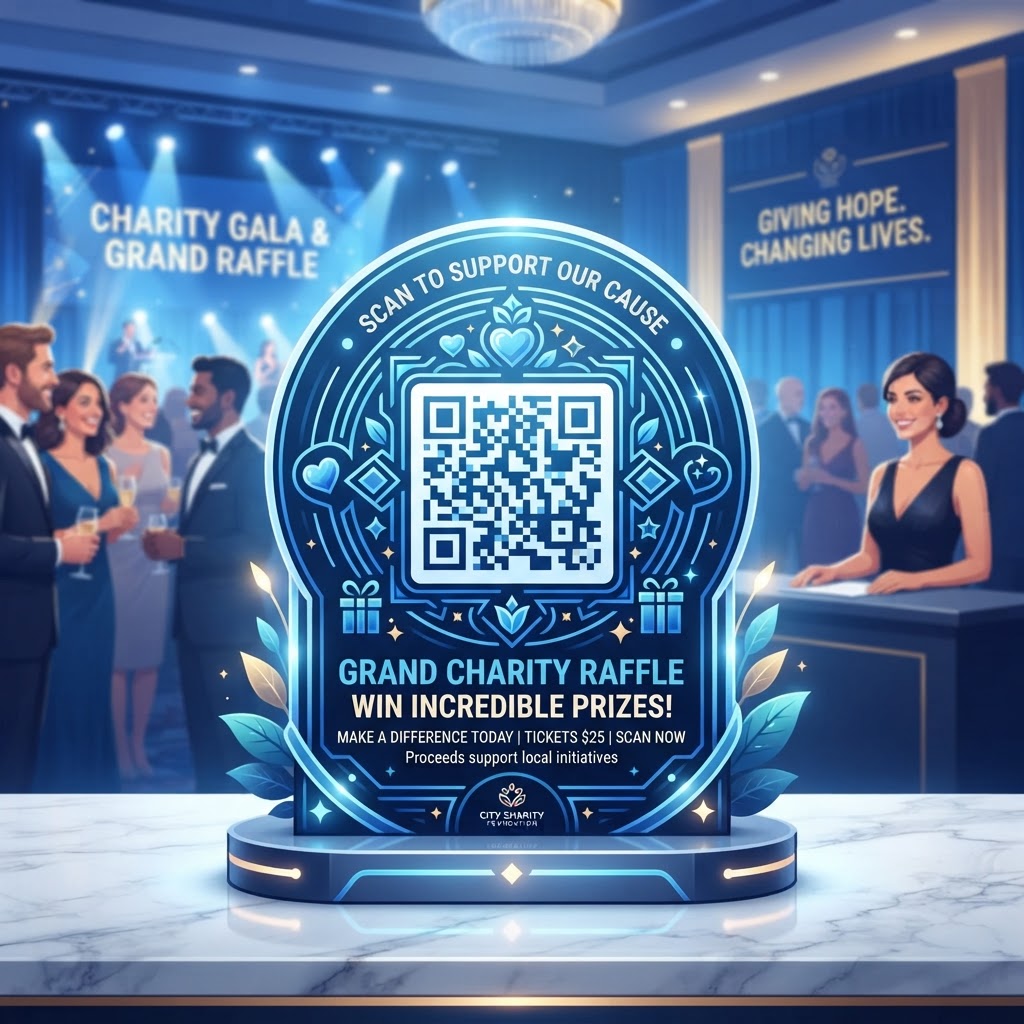
Why Using a QR Code for Charity Raffles Matters in 2026
The fundraising landscape has evolved significantly, and in 2026, efficiency and donor accessibility are the primary drivers of successful charity events. Traditional raffle methods, which often rely on physical booklets, manual cash handling, and paper ticket stubs, represent a significant operational burden for organizers.
These legacy systems are prone to human error, require immense administrative labor, and often result in lower participation rates because they rely on physical proximity to the ticket seller. By deploying a QR code for your charity raffle, you transition the operation into the digital realm, enabling participants to engage with your cause from anywhere at any time.
This shift is not merely about modernization; it is about meeting donors where they already reside—on their smartphones. As mobile technology continues to dominate personal interactions, the expectation for instant, contactless, and paperless transactions is at an all-time high.
Many businesses now rely on QR codes for everything from menu access to secure payments, normalizing the behavior for a broad demographic. When you use a QR code for your raffle, you eliminate the friction of physical ticket distribution.
Donors can scan a code from a flyer, a banner, or even a social media post, and be immediately directed to a secure mobile payment portal. This significantly increases the reach of your raffle beyond the physical venue of your event.
Furthermore, digital ticketing provides instant data collection, allowing your organization to track ticket sales in real-time. This visibility is invaluable for organizers who need to adjust marketing strategies on the fly or provide updates to donors, thereby fostering trust and transparency throughout the campaign lifecycle.
In 2026, if your raffle process requires a pen and a piece of paper, you are effectively leaving potential donations on the table. Adopting a mobile-integrated approach via blueqrcode.com ensures your fundraising stays competitive and donor-centric.
Key Points
- QR codes let donors participate from anywhere, beyond the physical venue.
- Digital ticketing can simplify ticket distribution and provide real-time sales visibility.
- A mobile-integrated raffle can help make the donor experience more convenient and accessible.
How It Works Technically: From Scan to Ticket Purchase
The technical architecture of a QR code raffle system is surprisingly straightforward, yet it offers deep functionality that supports complex fundraising needs. At its core, a QR code acts as a visual shortcut to a specific uniform resource locator (URL).
When a user scans the code using their device’s native camera, the OS automatically interprets the encoded information and triggers an action—most commonly opening a browser to a landing page. For a charity raffle, the QR code functions as the gateway to a web-based interface where the donation process is handled.
The destination URL typically links to a mobile-optimized checkout page or a dedicated raffle management platform. This ensures that the user experience is fluid and consistent, regardless of the smartphone model or operating system they are using.
Behind the scenes, the process involves several layers of security and data management. When a user lands on your raffle page, the site must be secure, typically utilizing encrypted pathways to ensure that donor payment information remains private.
Most modern smartphones have built-in capabilities to handle these redirects seamlessly. The beauty of the QR code is that it allows for the embedding of tracking parameters (UTM codes).
By using the tools available at blueqrcode.com, you can generate specific links that tell you exactly where a donation originated. Did the donation come from a QR code on a physical poster at the event, or did it come from a digital flyer shared on a community website?
This technical granularity allows for precise analytics. Furthermore, the raffle system often triggers an automated receipt or digital ticket delivery via email or SMS upon successful purchase.
This eliminates the need for physical ticket tracking, as the system logs every transaction against a unique user ID, making the final prize draw process entirely transparent and easy to audit at the conclusion of the event.
Try it now: Generate a free Qr Code For Charity Raffle →
Step-by-Step Guide Using blueqrcode.com
Getting started with your charity raffle implementation is a quick process that requires no specialized technical training. Follow these steps to prepare and deploy your QR code.
- Step 1: Finalize your raffle landing page, including all necessary legal disclosures, clear descriptions of the prizes, and a reliable payment gateway.
- Step 2: Navigate to blueqrcode.com, select the 'URL' category, and paste your landing page URL into the input field. If the address is exceptionally long, consider using a shortened URL to keep the QR code pattern less dense and easier for older smartphone cameras to scan.
- Step 3: Customize the QR code to align with your charity’s branding while maintaining enough contrast for easy scanning.
- Step 4: Generate the code, preview it, and test it immediately with your own device.
- Step 5: Download the code in a high-resolution format, such as PNG or SVG, so it remains sharp when printed on large-scale signage.
- Step 6: Integrate the QR code into your marketing materials, including posters, tickets, social media imagery, and email newsletters.
- Step 7: Keep the original link active and monitor the number of scans to gauge campaign engagement. If you need to change the destination URL in the future, remember that choosing a dynamic option allows you to update the link without needing to reprint the physical QR codes.
Best Practices for Deployment: Size, Placement, and Format
The effectiveness of a QR code is highly dependent on its physical or digital environment. For physical event locations, height matters: a QR code placed at eye level on a standee or a wall will receive significantly more engagement than one placed near the floor or high up on a ceiling banner.
Size is equally important. A small QR code on a large poster can be difficult to scan from a distance; conversely, a massive code might look overwhelming if not balanced with clear call-to-action (CTA) text.
- Make printed QR codes at least two inches by two inches.
- Keep the surrounding space—the 'quiet zone'—clear of busy patterns, graphics, or text that might interfere with scanning.
- Pair the code with clear instructions, such as 'Scan to Enter the Raffle' or 'Support Our Cause: Scan Here to Purchase Tickets.'
- Use high-contrast color combinations, such as black on white or dark blue on light grey.
- Avoid light-colored QR codes on dark backgrounds, as many older smartphone cameras struggle with the inverse contrast.
- For digital use, such as in an email newsletter or a social media post, optimize the file size for fast loading.
- Ensure the code is sharp and not blurry or pixelated, so it can function properly.
By following these deployment standards, you ensure that your raffle QR codes are accessible to the widest possible audience, maximizing the conversion rate of casual observers into active ticket holders.
100% Free — No signup required
Create your Qr Code For Charity Raffle in seconds
Common Mistakes to Avoid During Your Campaign
Even with the best tools, organizations often stumble into common traps that undermine their fundraising goals. Testing and preparation can help prevent these issues from interrupting your campaign.
- Failing to test the QR code across multiple platforms can leave older Android devices or budget tablets unable to scan it; test on several different devices and in various lighting conditions.
- Using a broken or outdated URL turns the QR code into a dead end; ensure your URL is permanent and your website is hosted on a reliable server capable of handling event traffic spikes.
- Using a desktop-formatted landing page can frustrate mobile users who have to pinch and zoom; optimize the raffle entry page for mobile devices with large buttons, clear input fields, and a streamlined checkout flow.
- Overcrowding the design surrounding the QR code with slogans or overlapping graphics can make it harder for scanning apps to identify the pattern correctly.
- Ignoring security indicators can make users wary of payment portals; provide clear information about the safety of their transaction on your landing page.
Avoiding these pitfalls will help ensure your raffle remains a smooth, professional, and profitable experience for all involved parties.
Concrete Use Cases by Industry and Sector
The versatility of QR codes allows them to be utilized effectively across various charitable sectors. Schools hosting 'Spring Fling' or 'Fall Carnival' raffles can print QR codes on student-led flyers and parent newsletters.
Instead of requiring parents to hunt down a physical volunteer to buy tickets, they can scan the code from home, complete the purchase, and receive their digital ticket numbers via email. This makes it possible for busy parents to participate without needing to be physically present on school grounds.
In the sports sector, athletic leagues can place QR codes on seating headrests or near refreshment stands during game days. During halftime, spectators can scan the code to enter a raffle for a signed jersey, with the proceeds going directly to team travel funds.
The impulse-buy factor at a sporting event is high, and a QR code capitalizes on that energy. Non-profit arts organizations provide another excellent use case.
During a gallery night or a theater performance, QR codes can be displayed on programs or near the stage entrance. Patrons can scan to support the arts by purchasing raffle tickets for a chance to win original artwork or backstage passes.
This is particularly effective because it bridges the gap between the aesthetic enjoyment of the event and the tangible act of giving. For religious and community organizations, QR codes placed on bulletin boards or displayed during services allow members to participate in raffles that fund local food pantries or building improvements.
The goal across all these sectors is to minimize the effort required to make a contribution. By meeting donors where they are, whether at a stadium, a gallery, or an office, you provide a low-friction pathway for charitable engagement that scales with your audience size.
Summary and Next Steps for Your Organization
In conclusion, the deployment of a QR code for a charity raffle is one of the most effective strategies for modernizing your fundraising and increasing donor participation in 2026. By removing the physical barriers of traditional paper-based raffles, you empower your donors to contribute when, where, and how they prefer.
Throughout this article, we have covered the critical components of a successful implementation: from the technical ease of using blueqrcode.com to the strategic deployment of signage and the avoidance of common, preventable mistakes. When properly executed, this digital approach does more than just simplify ticket sales; it fosters a professional, transparent, and modern image for your organization, which in turn builds long-term trust with your donor base.
Your next steps are straightforward. Start by mapping out your raffle timeline and ensuring that your mobile-optimized landing page is fully operational and secure.
Visit blueqrcode.com to generate your campaign QR codes, taking the time to test them thoroughly across different devices and environments. Once your materials are printed and your digital assets are ready, execute your launch campaign with clear instructions that tell donors exactly how to engage.
Monitor your traffic, observe where your scans are originating, and remain prepared to update your links if necessary. As you gather data, use these insights to refine your next fundraising initiative.
The combination of digital convenience and charitable cause is a powerful driver for success in the modern era. By taking the leap into QR-enabled fundraising, you are not just hosting a raffle; you are building a sustainable, accessible, and efficient model for charitable support that will serve your organization for years to come.
No watermark · No expiry · Works on all phones
Your QR code is ready in under 30 seconds.