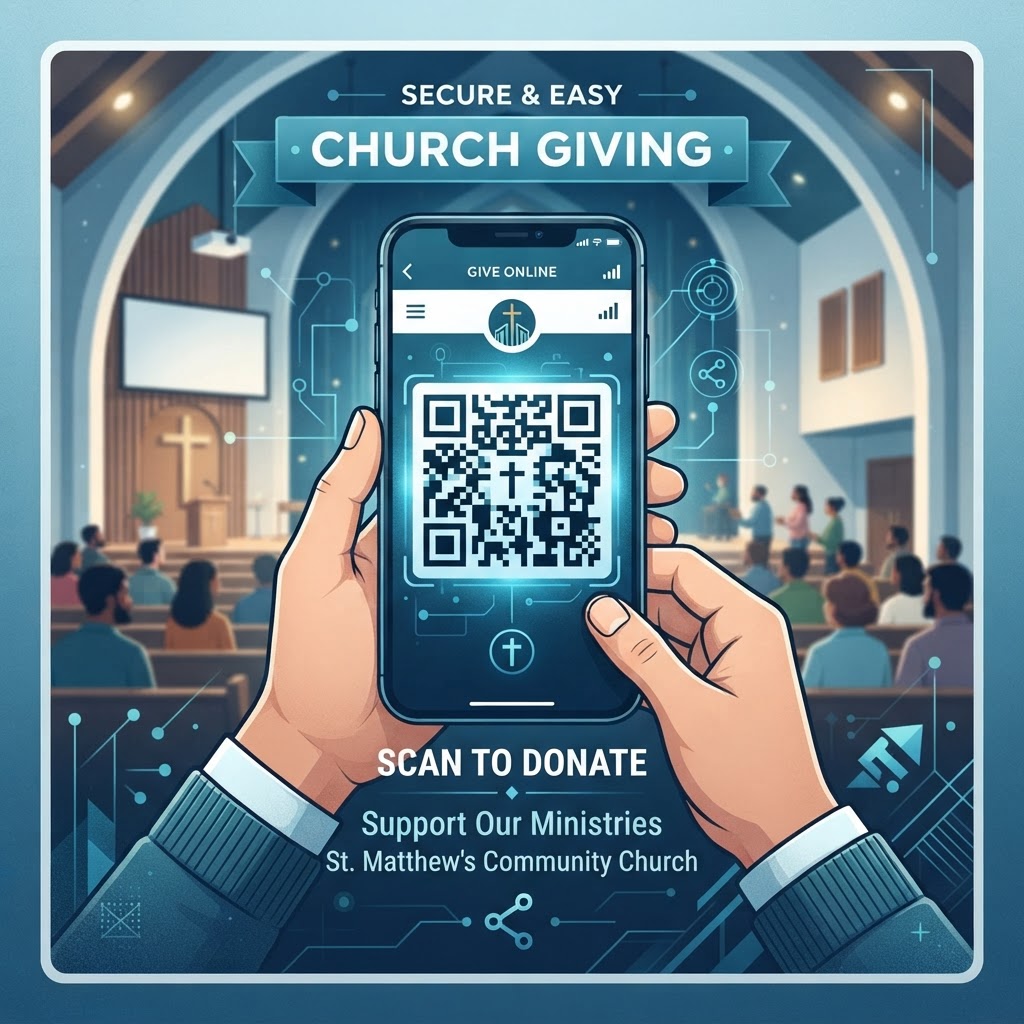
Why This Matters in 2026: The New Landscape of Stewardship
As we navigate the fiscal landscape of 2026, the traditional collection plate is facing an existential decline. The societal shift toward cashless transactions is no longer a niche trend; it is the standard behavior for the vast majority of congregants.
When a church fails to provide a digital-first option, they are effectively placing a barrier between the congregation and their ability to express generosity. A QR code for church giving solves this friction point by transforming a physical moment of worship into a digital act of service.
In 2026, the psychological barrier of 'not having cash on hand' is easily bypassed when a member can simply point their smartphone at a screen or a printed page to initiate a secure transaction. This capability ensures that spontaneity is not lost—if a sermon moves a listener to give, the infrastructure is already in place to facilitate that impulse immediately.
Furthermore, the data-driven advantages of digital giving are profound. When donations are processed through digital channels, the church gains immediate insights into giving trends, seasonal fluctuations, and the overall financial health of the organization.
This allows leadership to make informed decisions about budget allocations, charity work, and building maintenance without waiting for manual ledger counting. By integrating QR codes into the weekly flow of congregational life, churches are also signaling that they are relevant, transparent, and forward-thinking.
This aligns with a demographic of younger, tech-savvy families who expect organizations they support to meet them where they live: online and on mobile. Embracing these tools is not merely about convenience; it is a vital strategy for long-term sustainability in an era where digital agility is the primary indicator of institutional health.
As more churches adopt this technology, the expectation from the average attendee is that their place of worship will offer the same level of technological convenience they find at local businesses or charitable nonprofits. Failing to provide this creates a silent, invisible gap in community engagement that can accumulate significant financial impact over a fiscal year.
Key Points
- Digital giving removes the barrier of not having cash on hand and makes it easier for congregants to give in the moment.
- Digital donation data can help church leadership understand giving trends and make informed decisions.
- Offering mobile giving helps churches meet the expectations of tech-savvy families and remote attendees.
How It Works Technically: From Scan to Secure Transaction
At its core, a QR code for church giving is a matrix barcode that stores a specific destination URL. When a congregant scans the code using their smartphone’s built-in camera, the device interprets this URL and automatically opens the church’s donation landing page in a mobile browser.
Technically, the process relies on the ubiquity of universal QR scanning software built into almost every smartphone operating system currently in circulation. There is no longer a need for the end-user to download specific, cumbersome applications to interact with these codes.
Once the user scans the code, they are directed to a pre-configured, secure portal where they can input their donation amount and payment details. The process is incredibly streamlined, often taking less than ten seconds from the initial scan to the completion of a transaction.
To ensure security, the technical implementation usually involves an SSL-encrypted webpage, often hosted by a third-party payment processor specialized in non-profit and religious transactions. When using a tool like blueqrcode.com to generate your QR code, you are creating a stable, permanent gateway to this secure environment.
The QR code itself does not store sensitive financial data or banking information; it is simply a signpost—a digital shortcut—that directs traffic to your designated destination. This separation is crucial for security compliance; by keeping the donation portal separate from the QR code generation tool, the church maintains PCI compliance and protects sensitive donor data.
Behind the scenes, when the visitor arrives at the destination URL, the browser initiates a secure session. The ease of this redirection means that the user experience is fluid, provided the destination URL is optimized for mobile viewing.
High-speed mobile data and pervasive Wi-Fi availability in 2026 ensure that these transitions are near-instantaneous. The beauty of this technical architecture lies in its simplicity for the user and its robust security for the organization, bridging the physical gap between a church sanctuary and a secure, modern financial network without requiring any hardware modification at the site of the donation.
Try it now: Generate a free Qr Code For Church Giving →
Step-by-Step Guide Using BlueQRCode.com
Using blueqrcode.com to generate a QR code for your church is an intuitive process designed for users with any level of technical expertise.
- Prepare your donation page: Navigate to the website and select the URL QR code feature. Have your donation landing page URL ready and ensure that the page is mobile-responsive, as almost every user scanning your code will be on a smartphone.
- Enter and customize your URL: Copy your URL and paste it into the designated input field on the BlueQRCode generator page. Customize the appearance to match your church’s official colors or add a subtle logo to build trust with your donors.
- Generate and test your code: Click the generate button, then scan the code with multiple devices. Confirm that it leads to the correct page and that the page loads properly.
- Download your code: Once you are satisfied with its function, download the code in a high-resolution format, such as a PNG or SVG file. SVG is particularly useful if you plan to enlarge the code for banners or projection screens, as it will remain crisp at any size.
- Deploy and track your code: Embed it into your digital newsletter, print it on the back of your physical worship bulletins, or incorporate it into your slide deck for the Sunday service. Keep a record of where each specific QR code is placed, and use tracking links (UTM parameters) within your destination URL to distinguish which QR codes are performing best.
For example, tracking can help you understand whether more people donate via the bulletin or the sanctuary projection screen, allowing for smarter communication strategies in future campaigns.
Best Practices for Deployment: Size, Placement, and Format
The efficacy of a QR code for church giving is heavily dependent on how and where it is displayed. Strategic placement is the difference between a high engagement rate and total obscurity.
- Choose an appropriate size: A good rule of thumb for printed material is to make the QR code at least two inches by two inches. For projection screens, make it large enough to be scanned from the back row of the pews.
- Use a high-resolution format: Ensure the code has enough resolution to prevent pixelation, especially when displayed at a large size.
- Prioritize contrast: A black code on a white background is the gold standard for scan success rates. Avoid low-contrast combinations, such as light gray on yellow, as they can make it difficult for a scanner to distinguish the data points.
- Place it where people will see it: Include the QR code on the final slide of your service presentation or in a prominent position in your weekly printed bulletin.
- Add a clear call to action: Use a brief prompt near the code, such as 'Scan here to support our community programs' or 'Give safely and quickly.'
- Consider connectivity and conditions: If your church has poor cellular reception, consider placing a QR code for your local guest Wi-Fi next to the giving QR code. For outdoor settings or special events, use UV-resistant materials and avoid areas with high glare.
By treating the QR code as a piece of important signage rather than an afterthought, you validate its role in your ministry and encourage more frequent and comfortable use by your congregation.
100% Free — No signup required
Create your Qr Code For Church Giving in seconds
Common Mistakes to Avoid
Many churches, in their haste to implement new technology, fall into several predictable traps that can undermine their efforts. Avoiding these issues helps make the giving experience more seamless and reassuring for congregants.
- Using a broken link: Always verify that your donation portal is live and operational before printing thousands of bulletins or scheduling a projection.
- Neglecting mobile optimization: If a donor scans the code and is greeted by a desktop-formatted page that requires them to 'pinch and zoom' to find the donate button, they will likely abandon the transaction. The donation experience must be as seamless on a small screen as it is on a computer.
- Ignoring security transparency: People are naturally wary of scanning codes, especially in public spaces. Place the code near official church branding, or have a leader mention from the pulpit that the code is the official and secure method for mobile giving.
- Creating code clutter: Too many QR codes in one space can lead to confusion. If you have codes for the church newsletter, the donation page, and an upcoming event, label them clearly.
- Using links that expire: If you use a URL shortener that has a trial period, ensure you are aware of when that link might deactivate. Using a reliable and stable platform like blueqrcode.com ensures that your links remain functional long-term.
If your donation page is clunky, the QR code is only highlighting that deficiency to a wider audience, which is counterproductive to your goals. Broken links and unclear labeling can also damage trust in your digital initiatives.
3-4 Concrete Use Cases by Industry and Sector
While the focus here is on the church, the utility of QR codes extends into various community and non-profit sectors that operate similarly to church stewardship.
- Community Outreach Program: If your church runs a food pantry or a clothing bank, placing a QR code on the side of a donation bin or at the entrance of the facility allows people to make 'on-the-spot' financial donations to support that specific ministry. It transforms a physical act of bringing canned goods into an opportunity for financial contribution.
- Event Fundraising: During a benefit concert or a community festival, you can print QR codes on wristbands or tent cards placed at tables. This allows attendees to participate in silent auctions or 'give-in-the-moment' challenges without needing to carry cash or wait in line at a kiosk.
- Digital Stewardship: Many churches now broadcast their services globally via live streams. Placing a permanent QR code on the screen during the entire broadcast allows home viewers to contribute to the ministry in real time, creating a 'digital congregation' that is just as financially active as those sitting in the physical pews.
- Small Group and Bible Study: Leaders can print a QR code on the materials used during the study, allowing members to easily contribute to the specific cause the study is discussing, such as a local missionary trip or a scholarship fund.
By decentralizing the giving process and moving it out of the sanctuary and into every point of contact with your congregation, you multiply the opportunities for stewardship and make it a natural, ingrained part of your community’s lifestyle and identity.
Summary and Next Steps: Transforming Generosity
Integrating a QR code for church giving is a foundational step in bringing your organization into the digital age. By focusing on accessibility, security, and clear communication, you remove barriers to participation and allow your congregation to express generosity in the way that fits their modern lives.
We have explored the technical ease of implementation through blueqrcode.com, the importance of strategic physical placement, the necessity of mobile-first destination pages, and the common pitfalls that can be avoided with proper planning. The transition to digital giving is not merely a change in method; it is a change in culture—a move toward transparency, efficiency, and meeting your community where they are.
Your next steps are straightforward: evaluate your current giving portal to ensure it is mobile-ready, choose a consistent and professional design for your QR codes, and begin a phased rollout. Start by adding the code to your worship bulletins this Sunday, and follow up by including it in your email newsletters and on your website.
Use the data collected from these codes to listen to your congregation’s giving patterns, and adjust your communication accordingly. Do not be afraid to iterate; technology changes quickly, and your approach should be flexible.
By taking the time to set up this system correctly, you are ensuring that your church remains a robust, well-funded hub of community support for years to come. Start creating your code today at blueqrcode.com and see the immediate impact it can have on your mission.
No watermark · No expiry · Works on all phones
Your QR code is ready in under 30 seconds.
Conclusion
A QR code for church giving can help make stewardship more accessible when it is paired with a secure, mobile-ready donation page and clear communication. With thoughtful placement, careful testing, and a reliable destination link, churches can offer congregants a convenient way to support their mission.