1. Why this matters in 2026
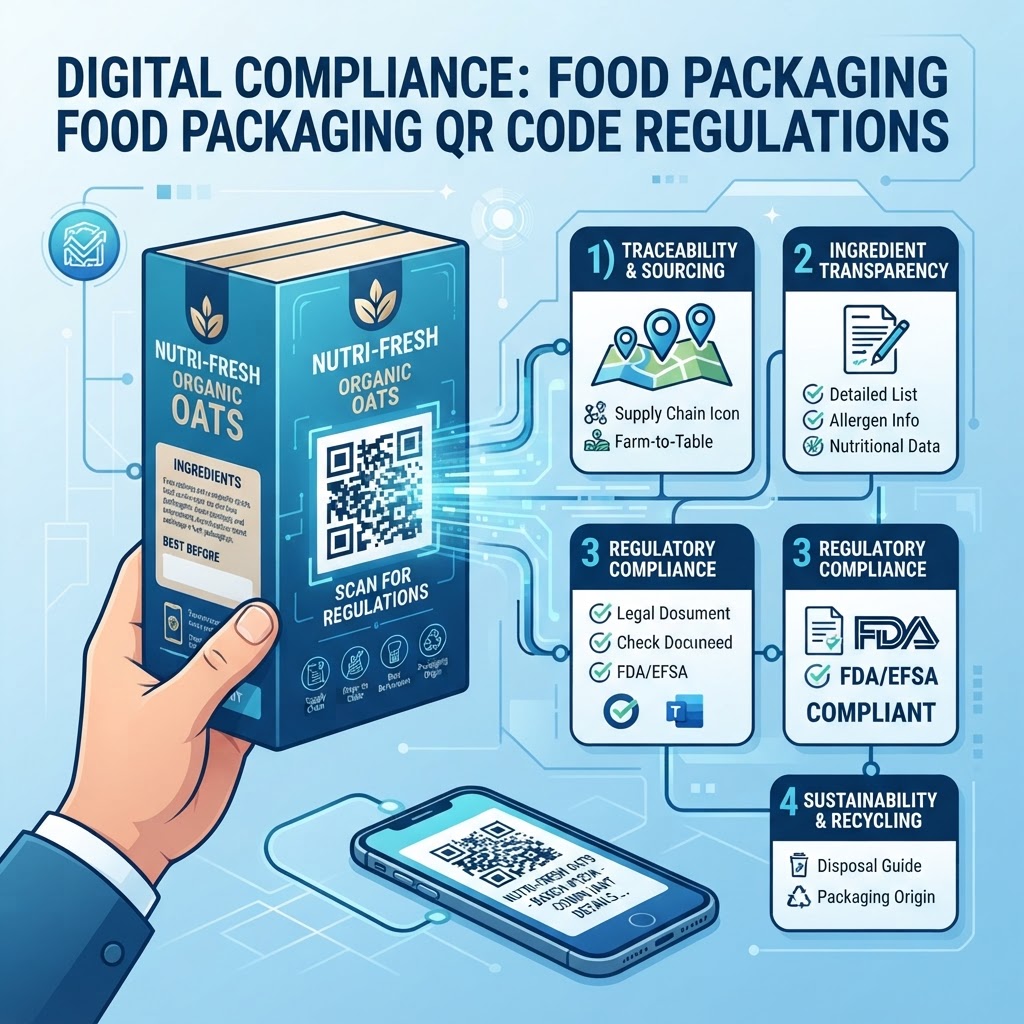
In 2026, the regulatory environment surrounding food labeling has reached a point of high digital saturation. Consumers have become accustomed to instant access to product details, ranging from localized sourcing information to precise manufacturing disclosures. Physical packaging, however, remains constrained by finite space. Labels must accommodate nutritional panels, ingredient lists, allergy warnings, and brand messaging, often leaving little room for extensive certifications or extended supply chain provenance. This is where the static QR code becomes an essential utility for modern food packaging compliance. By offloading additional information to a digital destination, producers ensure they are meeting transparency requirements without compromising the visual integrity of their designs.
Furthermore, businesses are finding that regulatory compliance is often easier to manage when consumers have self-service access to information. When a brand provides a direct link to digital specifications, it reduces the administrative burden on customer service departments regarding ingredient inquiries or sustainability questions. Because most smartphones are equipped with native camera-based QR readers, there is virtually no friction for the end-user. This creates a standard of communication that satisfies both the consumer’s demand for knowledge and the legal requirements for disclosure. Understanding these dynamics is crucial for any company operating in the food sector today. For those just starting their journey, learning how to make a QR code for a product is a foundational step in ensuring long-term success. By embracing this technology, brands demonstrate a commitment to openness that fosters trust, ensuring that every shopper has the ability to verify what they are purchasing while on the store shelf.
2. How it works technically
At a technical level, a QR code functions as a two-dimensional matrix barcode that encodes data in a visual pattern of squares. When a smartphone camera scans this pattern, the integrated software decodes the position markers and the data modules, ultimately translating them into a specific URL. For food packaging, the reliability of this process is paramount. Because the QR code acts as a gateway, it must be generated with high error correction levels to ensure that even if the packaging sustains minor surface damage, friction, or poor lighting conditions, the code remains functional for the consumer. This technical robustness is why using a dedicated, high-quality generation platform is vital for food brands.
It is important to understand that a static QR code, like those generated via blueqrcode.com, embeds the destination URL directly into the visual structure of the code itself. Once generated, the path is permanent and cannot be altered. This creates a "source of truth" for the regulatory information it links to. Because the information is stored on a fixed landing page or PDF, the physical packaging remains legally compliant even if the product itself remains on the shelf for months or years. The simplicity of this system—linking directly to a static resource—minimizes the risk of link rot or server-side complications that might arise with more complex, tracking-heavy systems. Most smartphones utilize optimized algorithms that scan these static patterns in milliseconds, even when the printed ink has a slight texture or is placed on a curved surface. This technical reliability ensures that the consumer experience remains seamless, professional, and compliant with accessibility standards for digital documentation.
3. Step-by-step guide using blueqrcode.com
Creating a compliant QR code for your food product packaging using blueqrcode.com is a straightforward process designed for efficiency and stability. To begin, first ensure your target content is ready—this could be a static webpage detailing ingredient sourcing, an official allergen disclosure document, or a PDF containing certification standards. Once your destination URL or file is confirmed, navigate to the Free QR Code Generator No Sign Up No Watermark to initiate the generation process. Enter your verified URL into the input field; make sure to use a secure, HTTPS-enabled link to maintain brand authority and protect consumer privacy. Being mindful of these security basics is a key component of modern regulatory compliance.
After inputting the URL, you have the option to customize the appearance of your code. For food packaging, it is best to maintain high contrast. Black modules on a white background provide the highest level of scannability. Avoid complex color gradients or inverted color schemes that might confuse lower-end mobile scanners or scanners used in dimly lit supermarket environments. Once you have finalized your design, simply download the image file. Ensure you download it in a high-resolution format, such as PNG or SVG, to ensure the code remains crisp and distinct when sent to your print vendor. By following this simple workflow, you can integrate digital transparency into your packaging lifecycle with zero recurring costs or complex management requirements. This approach is highly effective for smaller boutique manufacturers as well as large-scale processors who prioritize simple, effective, and free tools to meet their digital documentation goals.
4. Best practices for deployment (size, placement, format)
Deployment is a critical phase where even the most well-intentioned regulatory information can fail if the physical implementation is flawed. The primary rule is size and clearance: your QR code should ideally be at least 2cm by 2cm, though larger is often better depending on the print material. For textured packaging, such as cardboard or matte paper, the code needs to be large enough to compensate for potential ink bleed. Always leave a 'quiet zone' around the code, which is a clear, empty margin free of text, images, or branding graphics. This silence is necessary for the scanner to properly identify the boundary of the code against the background of the packaging design.
Placement should be intuitive. Most consumers look for supplemental information on the side or back panels of a product. Placing the code near the ingredients list or the nutritional information panel creates a logical flow for the consumer. When considering the printing process, consult with your packaging designer to ensure the ink used for the code does not have a reflective finish, as glare can effectively neutralize a QR code under supermarket lighting. If the packaging has a curved surface, such as a bottle, place the code in a way that minimizes distortion. A code that is wrapped too tightly around a tight-radius cylinder can be difficult for a camera to interpret. If you are struggling with specific placement challenges, our guide on QR Code Placement Best Practices provides a deeper dive into ensuring the integrity of your code during the production phase. Consistent testing on actual product samples before final print runs is essential for long-term reliability.
100% Free — No signup required
Create your QR Code on Food Packaging Regulations in seconds
Create Free QR Code →5. Common mistakes to avoid
A frequent error in the food industry is over-engineering the QR code implementation. Many brands attempt to use colorful, branded, or complex QR codes that, while visually pleasing, fail to meet the industry standard for contrast. A QR code that blends in too well with a brand's color palette often suffers from low scan rates because the software cannot distinguish the data modules from the surrounding art. Always prioritize functionality over aesthetics when it comes to regulatory labeling. If a consumer cannot scan the code, the information is effectively missing, which could lead to non-compliance issues if the link was intended to satisfy mandatory disclosure requirements regarding ingredients or allergens.
Another critical mistake involves using non-permanent destinations. A QR code is only as good as the link it connects to. When implementing a static code, ensure that the URL is a stable, permanent destination that will not expire or change. Using a link that might be broken in the future forces a reprinting of all packaging, which is an unnecessary financial burden. Furthermore, avoid placing the code in areas that are frequently handled, such as the bottom of a container or near a tear-strip, where damage during shipping or shelf stocking could physically obscure the pattern. Lastly, never assume that the consumer has perfect signal in every store; while the code itself works offline, the destination content should be optimized for quick loading even on modest mobile network connections. By avoiding these pitfalls, you ensure your packaging remains a reliable tool for transparency throughout its entire lifecycle on the shelf.
6. 3-4 concrete use cases by industry/sector
The application of QR codes in the food sector is incredibly diverse, benefiting various industry verticals in distinct ways. In the bakery sector, manufacturers often use QR codes to display extended lists of local ingredients and the specific provenance of grains. By linking to a simple, clean landing page, they provide assurance of local sourcing without overcrowding the bag. This fosters a connection between the bakery and the consumer, validating the higher price point of artisanal products through verified information. For those involved in the QR Code for Supermarkets space, these codes are also vital for displaying nutritional data for bulk items where individual label space is limited, helping satisfy local transparency mandates effortlessly.
In the beverage industry, producers of craft juices and functional drinks use QR codes to explain the specific health benefits of complex ingredient blends. Since these products often contain exotic botanical extracts, a quick scan allows a consumer to understand the origin and traditional use of those ingredients. This fulfills a dual purpose: it acts as a marketing educational tool and satisfies the regulatory need to provide clear, accessible documentation about product contents. Another major sector involves organic produce packaging. Retailers can use these codes to show the full journey of a product from the specific farm to the local distribution center. This creates a transparent supply chain, allowing consumers to scan the code while holding the produce to verify its organic status or fair-trade certification. Each of these examples demonstrates how a static QR code adds value by serving as an infinitely scalable digital extension of the physical product label.
7. Summary and next steps
Implementing QR codes on food packaging is an elegant solution to the increasing demands of the modern regulatory landscape. By providing a clear, high-contrast, and permanent digital path to vital information, brands can successfully navigate the complexities of 2026 labeling requirements. The process is simple: generate your static QR code at blueqrcode.com, test it thoroughly on your intended packaging substrate, and ensure that the landing content is informative, stable, and accessible. This strategy not only safeguards your business against potential compliance issues but also enhances the overall shopper experience, turning a standard label into a rich resource for consumer education and trust-building.
Moving forward, businesses should audit their current packaging to identify where digital supplementation is needed. Start by creating a library of stable URLs or documents that contain your regulatory disclosures. Once these are organized, use our generation tools to create the physical assets for your next print run. Remember that regulatory needs evolve, so keeping your digital documentation up to date is just as important as the code on the package itself. By adopting these best practices now, you position your brand as a leader in transparency and operational efficiency. The integration of QR technology is a long-term investment in your relationship with your customer base. Take the first step today by preparing your digital assets and utilizing the resources available on our platform to build a more informative, compliant, and trustworthy product line for your consumers, ensuring that every product on the shelf effectively communicates your brand values and adherence to regulatory standards.
No watermark · No expiry · Works on all phones
Your QR code is ready in under 30 seconds.
Generate Free QR Code →